

📈 Google Ads Strategies: 10 Powerful Ways to Get Better Results
Google Ads strategies are among the most powerful ways for businesses to reach potential customers when they are actively searching for products or services. With the right strategy, businesses can attract targeted traffic, generate leads, increase sales, and make better use of their advertising budget.
However, successful advertising is not simply about creating an ad and setting a budget. Effective Google Ads strategies require keyword research, compelling ad copy, accurate conversion tracking, quality landing pages, and continuous optimization.
In this guide, we will explore 10 powerful Google Ads strategies that can help businesses improve campaign performance and achieve better results.
🔍 What Is Google Ads?
Google Ads is Google’s online advertising platform that allows businesses to promote products and services across Google Search, YouTube, websites, apps, and other advertising placements.
For example, when a potential customer searches for “WordPress website developer,” a web development business can use Google Ads to display an advertisement for its services.
This gives businesses an opportunity to reach people who are already interested in a particular product or service.
Unlike traditional advertising, where an advertisement may be shown to a broad audience, Google Ads allows businesses to target specific searches, locations, audiences, devices, and other signals.
The main objective of effective Google Ads strategies is not simply to get clicks. The objective is to attract relevant visitors and turn those visitors into valuable leads or customers.
🚀 Why Google Ads Is Important for Businesses
Businesses use Google Ads for several important reasons.
🎯 Reach Customers With High Purchase Intent
One of the biggest advantages of Google Ads is search intent.
Consider searches such as:
- 🛋️ “buy office furniture online”
- 🔎 “SEO expert for small business”
- 💻 “professional WordPress developer”
- 📊 “Google Ads management service”
These searches can indicate that the user is actively looking for a product or service.
By targeting relevant searches, businesses can reach potential customers at an important stage of their buying journey.
🌐 Generate Targeted Website Traffic
Google Ads allows advertisers to target relevant keywords and audiences instead of relying only on organic website traffic.
Advertisers can also target locations, languages, devices, and audience segments depending on their campaign objectives.
This can help businesses focus their advertising budget on potentially valuable users.
📊 Measure Advertising Performance
Another major benefit of Google Ads is measurable performance.
Advertisers can monitor metrics such as:
- 👁️ Impressions
- 🖱️ Clicks
- 📈 Click-through rate (CTR)
- 💰 Cost per click (CPC)
- ✅ Conversions
- 📊 Conversion rate
- 💵 Cost per conversion
- 🛒 Return on ad spend (ROAS)
These metrics provide useful data for making informed optimization decisions.
🔥 10 Powerful Google Ads Strategies for Better Results
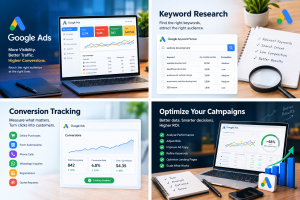
1. 🔎 Perform Detailed Google Ads Strategies: Keyword Research
Keyword research is the foundation of an effective Google Ads campaign.
Instead of choosing keywords only because they have high search volume, advertisers should consider relevance and search intent.
For example, a web development company could target keywords such as:
- 💻 WordPress website development
- 🎨 Professional website design
- 🏢 Business website developer
- 🛒 E-commerce website development
- 🌐 WordPress developer
These keywords are useful when they closely match the services being offered.
Good keyword research is a core part of Google Ads strategies because it helps advertisers understand what potential customers are searching for and how those searches relate to their business.
2. 🎯 Choose the Right Keyword Match Types
Google Ads provides keyword match types that help advertisers control how closely a user’s search should relate to a keyword.
The main match types are:
- 🔵 Broad Match
- 🟢 Phrase Match
- 🟠 Exact Match
Each match type provides a different balance between reach and control.
Advertisers should choose match types based on their campaign goals and regularly review search terms to understand which searches are triggering their ads.
This process can help improve traffic quality and reduce unnecessary spending.
3. 🚫 Use Negative Keywords
Negative keywords are an important part of successful Google Ads strategies.
They help prevent advertisements from appearing for irrelevant searches.
For example, suppose a company sells professional website development services but does not offer free website services.
Searches such as “free website builder” may attract users who are unlikely to become paying customers.
Adding relevant negative keywords can reduce unwanted clicks and help protect the advertising budget.
4. ✍️ Write Powerful and Relevant Ad Copy
Effective ad copy is a key part of Google Ads strategies and should quickly communicate the value of a product or service.
A good advertisement should be:
- ✅ Clear
- 🎯 Relevant
- 💡 Specific
- ⭐ Benefit-focused
- 👀 Easy to understand
Example Google Ad
Headline:
Professional WordPress Website Design
Description:
Get a responsive and professional WordPress website for your business. Contact us today.
The advertisement should closely match the user’s search and the content of the landing page.
When the keyword, advertisement, and landing page are relevant to one another, the user experience can be much stronger.
5. 🌐 Create a High-Quality Landing Page
Getting a click is only the beginning of a successful Google Ads campaign.
After clicking an advertisement, visitors should arrive on a relevant and user-friendly landing page.
A strong landing page should:
- ⚡ Load quickly
- 📱 Work properly on mobile devices
- 💡 Clearly explain the offer
- 👉 Include a strong call to action
- 🔒 Build customer trust
- 📝 Provide useful information
- 🎯 Make the next step simple
For example, if an advertisement promotes WordPress website design, sending users to a dedicated WordPress service page can be more effective than sending every visitor to the homepage.
6. 📊 Set Up Google Ads Conversion Tracking
Conversion tracking is one of the most important parts of successful Google Ads strategies.
Clicks and impressions are useful, but they do not necessarily represent business success.
A conversion could be:
- 🛒 An online purchase
- 📝 Contact form submission
- 📞 Phone call
- 💬 WhatsApp inquiry
- 📅 Booking
- 👤 Registration
- 💰 Quote request
Proper conversion tracking helps advertisers understand which campaigns, advertisements, and keywords are generating valuable actions.
Without reliable tracking, it can be difficult to determine where the advertising budget is producing real business results.
7. 📈 Monitor Important Google Ads Metrics
Regular performance analysis is essential for successful Google Ads management.
🖱️ Click-Through Rate
Click-through rate (CTR) measures the percentage of people who click an advertisement after seeing it.
A relevant and compelling advertisement can encourage users to visit the website.
💰 Cost Per Click
Cost per click (CPC) represents the amount paid for a click.
Monitoring CPC can help advertisers understand how efficiently their advertising budget is being used.
✅ Conversion Rate
Conversion rate measures the percentage of visitors who complete a desired action after clicking an advertisement.
A campaign can receive many clicks but still produce poor results if visitors do not convert.
💵 Cost Per Conversion
Cost per conversion shows the average advertising cost required to generate a conversion.
This can be especially important for businesses focused on lead generation.
🛒 Return on Ad Spend
Return on ad spend (ROAS) compares revenue generated from advertising with advertising costs.
For e-commerce businesses, ROAS can be a valuable metric for evaluating advertising performance.
8. ⚙️ Optimize Google Ads Strategies Regularly
Launching a campaign is not the end of the process.
Successful Google Ads campaigns require regular monitoring and optimization.
A simple optimization workflow can look like this:
🔎 Research → ⚙️ Setup → 🚀 Launch → 📊 Track → 🔍 Analyze → 🛠️ Optimize → 🧪 Test → 📈 Scale
Advertisers can review:
- 🔎 Search terms
- 🔑 Keywords
- 🚫 Negative keywords
- 📢 Advertisement performance
- 🌐 Landing pages
- 👥 Audience performance
- 📊 Conversion data
- 💰 Budget allocation
The goal is to identify what works, reduce wasted spending, and improve campaign performance over time.9. 🧪 Test Different Google Ads
Testing is another powerful strategy for improving Google Ads performance.
Instead of assuming that one advertisement will always perform best, advertisers can test different:
- ✍️ Headlines
- 📝 Descriptions
- ⭐ Benefits
- 🎁 Offers
- 👉 Calls to action
For example, one advertisement might emphasize:
“Professional Quality”
while another might focus on:
“Affordable Pricing”
Performance data can then help determine which messaging is more effective.
Testing should be based on meaningful data rather than making random changes to campaigns.
10. 🎯 Optimize Google Ads Strategies Around Business Goals
The final step in effective Google Ads strategies is to optimize campaigns according to actual business objectives.
Different businesses have different goals.
🛒 E-commerce Store
Goal: More online purchases
📍 Local Service Business
Goal: More phone calls
💼 Freelancer
Goal: More client inquiries
💻 Software Company
Goal: More free trials
Therefore, campaign optimization should focus on valuable business actions instead of clicks alone.
🔄 Google Ads and SEO: What Is the Difference?
Google Ads strategies and SEO both help businesses gain visibility on Google, but they work in different ways.
Google Ads provides paid advertising placements. Businesses pay to display advertisements when users perform relevant searches or meet selected targeting criteria.
SEO (Search Engine Optimization) focuses on improving a website’s organic visibility in search engine results.
Both strategies can work together.
For example, a business can use Google Ads to generate targeted traffic while also investing in SEO for long-term organic growth.
This combination can create a stronger overall search marketing strategy.
⚠️ Common Google Ads Mistakes to Avoid
Even a well-funded campaign can perform poorly if basic mistakes are made.
🎯 Targeting Too Broadly
Overly broad targeting can generate irrelevant traffic and unnecessary advertising costs.
🚫 Ignoring Negative Keywords
Failing to review search terms can result in advertisements appearing for searches that are not valuable to the business.
🌐 Using Poor Landing Pages
A slow, confusing, or irrelevant landing page can reduce conversions even when advertisements receive clicks.
📊 Not Tracking Conversions
Without conversion tracking, advertisers may not know which campaigns are generating actual business results.
🖱️ Focusing Only on Clicks
More clicks do not always mean better results.
The quality of traffic and number of valuable conversions are often more important than the total number of clicks.
👨💻 How a Google Ads Expert Can Help
Using Google Ads strategies effectively requires more than creating an advertisement and setting a budget.
A professional advertising strategy can include:
- 🔎 Keyword research
- 🕵️ Competitor research
- ⚙️ Campaign structure
- ✍️ Ad copywriting
- 🎯 Audience targeting
- 🚫 Negative keyword research
- 📊 Conversion tracking
- 🌐 Landing page analysis
- 📈 Performance monitoring
- 🛠️ Campaign optimization
The goal is to create an organized advertising system focused on relevant traffic and measurable business results.
For businesses that do not have enough time or experience to manage campaigns themselves, professional Google Ads management can make the process more structured and data-driven.
🔗 Helpful Google Ads Resources
For more detailed guidance, review the official Google Ads Help resources on keyword matching and search terms. Use normal follow links when adding these resources to your WordPress post.
- Google Ads keyword matching: https://support.google.com/google-ads/answer/14996023
- Google Ads search terms report: https://support.google.com/google-ads/answer/2472708
🔗 Recommended Internal Links
Add internal links from this article to your existing pages using natural anchor text:
- Digital Marketing Services
- Google Ads Management
- Projects
- Contact Me
Use the real URLs of those pages on your website. Do not use # placeholders.
🖼️ Featured Image SEO
Use a relevant Google Ads image and set the image ALT text to:
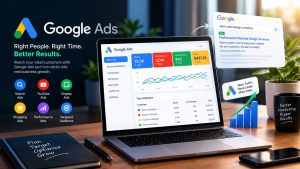
Google Ads strategies for better advertising results
💡 Final Thoughts
Google Ads strategies can be a powerful digital marketing solution for businesses that want to reach potential customers, generate leads, increase sales, and grow their online presence.
However, successful advertising does not happen simply by setting a budget and launching a campaign.
Effective results require keyword research, relevant advertisements, high-quality landing pages, accurate conversion tracking, regular analysis, and continuous optimization.
The goal should not simply be to get more clicks.
The real goal is to attract the right audience, generate valuable conversions, and use the advertising budget efficiently.
If you are planning to advertise your business online, a well-planned Google Ads strategy can become an important part of your digital marketing plan.
🚀 Want to Improve Your Advertising Strategy?
Explore my Digital Marketing Services, check out my Projects, or Contact Me to discuss your advertising goals.
📈 Better Strategy. Better Targeting. Better Results.